[6 min read]
The little things duty eats first, and how to start noticing again.
There’s a version of you that gets looked after only once everyone and everything else has been. She’s had a lot of practice waiting.
We become our own best gatekeepers.
When Duty Becomes Your Default
For a long time, mine was a private, moving bar. Rest once things had calmed down. Treat myself once I’d earned it. Enjoy some guilty pleasure once I’d cleared enough off the list to justify it. These were the things I had been putting off – until I was thin enough, organised enough, successful enough or somehow just ‘enough’ to deserve it.
Yours may be whatever small pleasure gets quietly rationed in your version of a duty-driven day. Finishing a film instead of half-watching it while you fold washing. A nap in the middle of the day that needs no headache to justify it. Dessert before dinner, because my mother-in-law always said you should, and she wasn’t wrong.
Some of that bar-setting is plain exhaustion talking. But some of it’s a bit more tangled … when being the dependable one becomes most of what you know about yourself, resting can begin to feel less like skipping a task and more like betraying the job description.
None of this arrives as a single loss you’d notice and grieve properly. It’s not a switch flipped off – it’s a dimmer, turned down one imperceptible notch at a time, for years, until low light starts to look like how things are simply supposed to look. You don’t decide to stop having pleasure. You just stop noticing its absence.
This isn’t a pitch for bigger treats. Not the spa day, the luxury weekend, the reward you’re saving up for “someday.” Those have their place, but they were never really the issue. The issue is less obvious and far more constant – dozens of ordinary moments quietly swallowed by duty, one “I’ll enjoy that later” at a time.
For me, it showed up at breakfast, of all the unglamorous places. I’m a morning person, so mornings were exactly where duty had the most room to move in unnoticed. A quick dog walk. Emptying the dishwasher. A load of washing on. Bins out. Grocery list updated. Emails opened before I’d even sat down. Most days, breakfast itself was a smoothie, drunk standing at the counter while my laptop booted up – fuel, not a meal. Somewhere in there, “good morning” had quietly become a checklist with no actual morning (or good bits) left inside it.
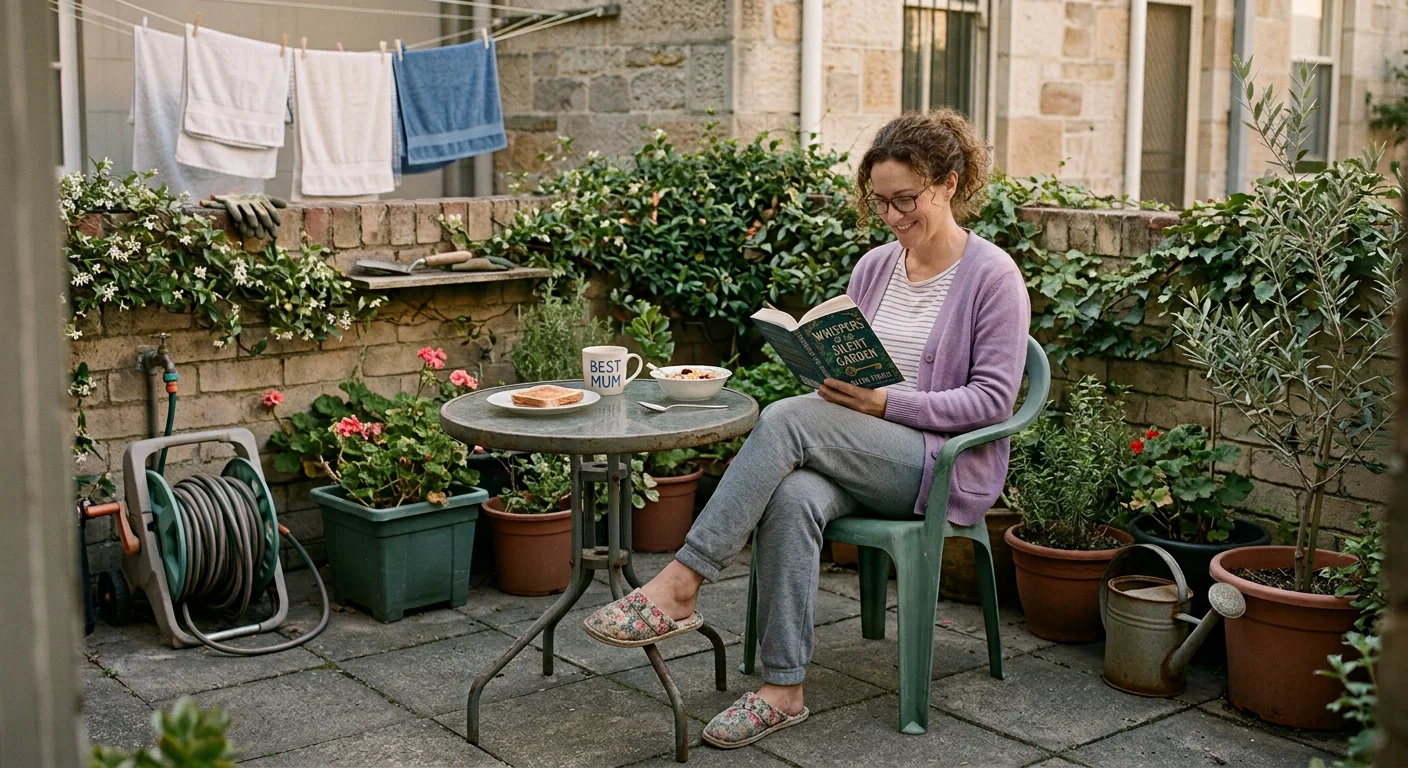
What changed wasn’t dramatic. Started with sitting down. Properly – plate, chair, no screen, half an hour I wasn’t trying to reclaim for something more productive. That’s it. Unremarkable, but a revolution nonetheless.
Pleasure isn’t the opposite of responsibility. You still have a household to run. People who need you. A dishwasher to stack. Tedious jobs. Commitments.
This doesn’t mean duty’s the villain. But if every available inch of a day gets allocated to what’s necessary, there’s nothing left over for what makes the necessary bits worth doing at all.
Pleasure Isn’t Self-Indulgent
Say “pleasure” out loud in a piece like this and most people’s brains helpfully supply: candles, bubble baths, a glass of wine, a box of chocolates. Perfectly nice things, and also not remotely the point.
Pleasure isn’t pampering. Pampering is something done to you, usually passive, usually purchased. (And sometimes requiring prompting) Pleasure is simply the experience of enjoying being alive – and it turns up in far stranger places than a spa menu. Novelty. Beauty. Play. Curiosity. Anticipation. Creativity. Movement. Connection. Sensuality. Laughter. Achievement. Adventure – or nothing more sophisticated than doing a thing purely because you want to.
Too often, we make the mistake of believing pleasure only comes from the relaxing stuff, when you can get just as much pleasure from things that are challenging, awkward or completely undignified. Like learning a difficult skill, swimming somewhere cold enough to make you swear, singing karaoke badly, that shred session at the gym, or two tissue packs into a sad movie. None of that is restful. All of it counts.
Once pleasure stops being confined to “things you do to recover”, it stops sounding like indulgence and starts sounding like what it actually is: a sign of life.
What Have You Stopped Wanting?
Here’s the part that duty is sneakily good at hiding. Duty doesn’t just consume your time. Over enough time, it trains you out of wanting.
Spend more years than you dare count fielding what needs doing, who needs you, what should you be doing, what would be sensible, what can wait and you become extremely good at spotting obligation.
Meanwhile, a different skill quietly atrophies from disuse: knowing what you genuinely want. Not the big, five-year-plan version of wanting. The small, immediate kind. I want to see that comedian. I want to wear the ridiculous earrings. I want to go somewhere I’ve never been.
That’s not indulgence. That’s expansion.
It’s easy to overlook the fact that for a lot of women, midlife can be the first real stretch of life where there’s finally room to ask yourself what you truly desire.
Not necessarily because you have more time – life can stay ridiculously full. But circumstances are shifting around you. Kids have grown and flown. Jobs plateau. Friendships drift. Parents age. Our bodies take on a life of their own. And the old operating system – be useful, be responsible, get everything done – doesn’t automatically fit the new circumstances just because it’s familiar.
Which raises an interesting question: if nobody’s actually asking you to spend every waking minute being useful, why are you still doing it?
The truth is, you don’t fix twenty years of habitual reliability by deciding, once, to want things differently.
Pleasure is a muscle, and it’s been getting no reps while duty’s been training daily. You don’t rebuild that with one grand gesture, a booked holiday, a big declaration. Think ridiculously small instead.
Notice what catches your attention. Notice what you’re looking forward to, versus what you’re just getting through. Notice what makes you laugh, properly, not politely. Notice the difference between feeling energised and merely feeling relieved to be done. And notice the thought “I’d love to do that…” – then notice what comes immediately after it. For most of us, it’s “but.” That word is worth interrogating every single time it shows up.
The Practice, Not the Permission
You don’t need to earn the right to take care of yourself. You just need to start.
Call it what you want. Mine’s the Mojo Mutiny: the moment you stop following the good-girl rules and launch a mini rebellion against your own boredom and invisibility. It doesn’t need to be loud. Most rebellions that stick usually aren’t.
Here’s the distinction that matters most, though: you don’t need permission to want any of this. You never did. What you need is practice – because two or three decades of a duty-driven life doesn’t automatically unlearn itself the moment someone tells you that you’re allowed to want more.
Noticing what you want, and then doing something about it, is a skill exactly like any other. It gets better with repetition, not with more of the same.
So, the real question – bigger than any one dessert or any one breakfast: what have you been rationing, or quietly treating as optional, that actually makes your life feel like yours?
Practice needs reps, and reps need a nudge. Every week, Hot Flashes lands in your inbox with an unvarnished take on midlife, a story or two, and one small thing to do before the week’s out. Join the list here.